




Dental caries under the microscope: Do baby teeth need to be treated?

Children's primary teeth : what causes them to develop cavities ? Should they be treated ? Or should they wait until they fall out on their own, especially if your child is afraid of visiting the dentist? When is root canal treatment or extraction necessary for primary teeth ? What preventative treatments are recommended for primary teeth? How can you avoid the need for treatment for primary teeth in children? Read our guide to properly care for your child's first teeth.
"Should I treat baby teeth or wait for them to fall out on their own? They're not permanent teeth – is there any point in spending money on them?" – these are the questions many parents of children with cavities in their baby teeth ask themselves. It's worth debunking a basic myth right from the start and emphasizing: teeth should ALWAYS be treated – regardless of whether they are baby teeth or permanent teeth. This is crucial not only for the child's quality of life but also for the condition of their future permanent teeth.
Caries of milk teeth: where does it come from?
Dental caries is a chronic, infectious disease affecting up to 90% of the Polish population. It is caused by toxins and acids produced by bacteria residing in dental plaque, which forms on teeth throughout the day (and even at night). Primary teeth and dental caries – this very common association stems from several factors.
 Improper oral hygiene of a child promotes the deposition of plaque. Inexperienced hands are often unable to thoroughly clean all the nooks and crannies. Therefore, after a toddler brushing his / her own teeth, it is worth for the parent to take the toothbrush for a while and to sensitively clean the more inaccessible places. We brush the teeth at least twice a day, preferably after each meal.
- Milklets are less mineralized and calcified. The enamel of deciduous teeth is even 2 times thinner than the enamel of permanent teeth, moreover, it has a more irregular structure, favoring the deposition of plaque. The thickness of the enamel and its susceptibility to caries may also be hereditary (if there are large problems with the teeth in the family, the child may also be more likely to develop cavities, from an early age).
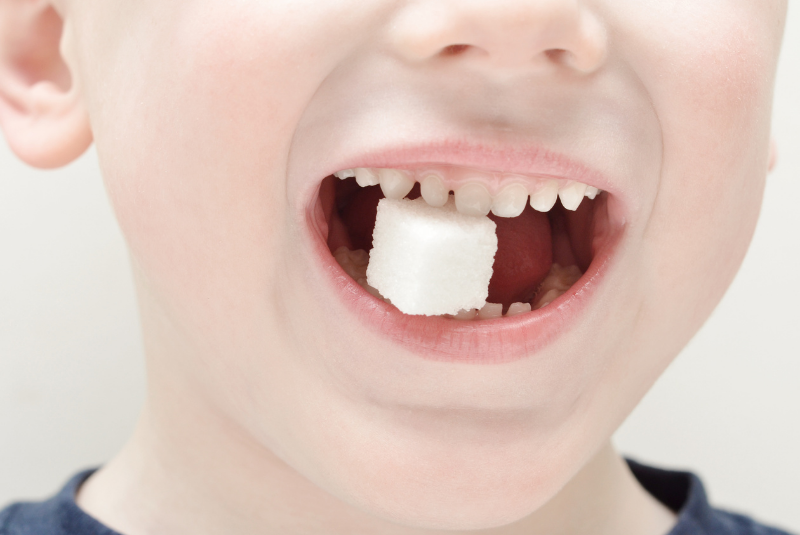
- Dietary mistakes in children: low supply of vitamins, minerals and proteins and frequent consumption of sugar-rich products and drinks (especially those that "stay" in the mouth, e.g. jelly beans, hard candy, corn crisps or caramels)
- Putting down during feeding (promotes the so-called bottle caries).
Tip: Because tooth decay is an infectious disease, it's very common in children whose parents struggle with tooth decay. So, if you have dental problems, avoid licking a pacifier or spoon before putting it in your child's mouth.
How is caries in milk teeth?
Tooth decay develops in several stages – the earlier it is detected, the easier it is to treat.
- Initial caries first we see a matte white spot on the tooth. This is where the enamel has softened and damaged by bacteria. This stage of caries is reversible if the parents intervene quickly and care for the baby's teeth (dental check-up, regular home hygiene and proper diet).
- Superficial caries when a spot on a tooth is left untreated, it begins to darken and grow: the so-called ,,a hole in a tooth". At this stage, caries only affects the enamel, but dental intervention is necessary to stop it from spreading further.
- Average caries penetrates deep into the tooth, the enamel and dentin are attacked.
- Deep caries it involves inflammation of the tooth pulp in the immediate vicinity of the nerve.
Due to the very structure of baby teeth, tooth decay develops at a rapid pace – therefore, careful observation is important (including regular visits to the dentist, at least once every six months) and a quick response to any changes in baby teeth.
Expert advises
Untreated decay of primary teeth may lead to the formation of abscesses and even the infection of permanent tooth buds, which are located "under" the diseased milk tooth. The decay of primary teeth is rapidly transferred to the remaining teeth, affecting the entire bite of the current and future bite (there may be irregularities in eruption and shaping of permanent teeth).


Treatment of milk teeth: how to prevent it?
In addition to a diet rich in fresh fruits and vegetables (including harder ones that can be chewed, naturally cleaning teeth) and low in sugar , proper daily oral hygiene is crucial. This can be practiced even in children who don't have teeth yet. Simply cleaning your baby's gums twice a day with gauze soaked in warm water will help protect emerging teeth from the first attacks of tooth decay.
Older children can be encouraged with colorful toothbrushes and toothpastes for children, which will make taking care of oral hygiene more attractive. It is worth checking the child during such hygienic activities to make sure that he is doing them correctly.
Expert advises
It may be a good idea to brush your teeth together - after all, children learn best by imitating their parents' good habits! However, it should be remembered that the toddler is not yet skilled in thorough brushing, so when he cleans his teeth on his own, it is worth taking the brush from him and cleaning the milk teeth once more. We try to wash the cloves after each meal. If for some reason it is difficult to do, the child should reach for the toothbrush at least twice a day, preferably after breakfast and just before going to bed.
Prevention caries of milk teeth at the dentist
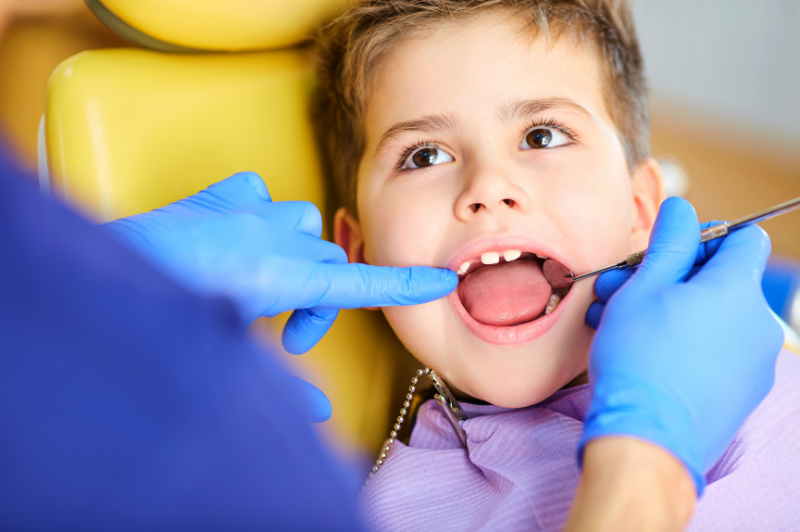
It is worth emboldening a child from an early age to a dental chair. Even a seemingly small spot may mean an advanced caries process under the enamel. We visit the dentist with the child at least twice a year for checkups and caries prophylaxis treatments, such as:
- Fluoridation: a painless, safe procedure that covers the teeth with a layer of bactericidal fluoride, which also has enamel remineralising properties (i.e. it can cure the first stage of caries!).
- Sealing: filling the spaces / furrows of healthy teeth with a special, lamp-hardened preparation (varnish). This is to protect those places that are difficult to access when brushing against the development of caries. The treatment is painless and very effective.
Besides regular visits to the dentist, daily oral hygiene is the foundation of healthy teeth for your child . Cavity prevention is the simplest, cheapest, and completely painless way to ensure healthy baby teeth in children.
Treatment of milk teeth without drilling
If caries has not yet attacked the tooth pulp, the dentist can offer modern, completely painless treatment methods.
- Ozonation: this gas (ozone) helps to get rid of bacteria and viruses in small cavities and also helps heal more advanced holes in milk teeth. Ozonation takes place locally (the sick tooth is surrounded by a special cover under which ozone is pumped in) and is completely safe for health, quick and completely painless. After the procedure, the defect is covered with a bactericidal preparation + very, very gently, painlessly drilled in order to put on a small filling. Ozone treatment is not as effective as lapping, but it is an alternative to it.
- Lapisetting: this is otherwise called lamination of teeth, i.e. covering them with silver nitrate. The treatment is also completely safe and painless. It is true that it does not eliminate carious lesions, but it allows you to prevent their further development and spreading to other teeth. Lapisering leaves a permanent, dark deposit on the milk teeth, but allows it to be preserved milk teeth without drilling as long as possible. We repeat the treatment 3 times at weekly intervals. To maintain the effect, lapping should be repeated regularly, every 3 months.
After such visits to the dentist, we should still remember about the daily, proper oral hygiene of the child.
Root canal treatment of milk teeth - is it worth it?
Root canal treatment is used when tooth decay has already caused inflammation of the tooth pulp . After thoroughly cleaning the tooth of infected tissue, the canal is left empty or filled with a special preparation that will be absorbed along with the tooth root. The filling itself is placed in a child in the same way as in an adult – except that the young patient can choose the color of their filling as a reward for the treatment! Raspberry or "Smurf" fillings are sure to please the brave patient.
Root canal treatment of primary teeth can be performed under local anesthesia, after the administration of laughing gas, or under full general anesthesia (only in justified cases). We perform root canal treatment to protect the child from further pain (untreated primary teeth are very painful!) and to protect the tooth from extraction (pulling out).
Whether to extract decayed milk teeth?
Yes, but only in cases of extreme necessity – that is, when other treatment methods are unfortunately too late or root canal treatment has not yielded the desired results (e.g., a recurrent abscess develops). Too early or hasty extraction of a primary tooth can delay and disrupt the eruption of the permanent tooth in that location, and also lead to improper (crooked) growth of other teeth adjacent to the cavity. After a primary tooth extraction, it's always a good idea for a child to consult an orthodontist, who can recommend the use of a space maintainer, a special metal or plastic cap for the teeth adjacent to the gap created by the extraction. This allows the permanent tooth that will erupt in its place to develop properly.
Hygiene and prevention, above all
In summary , the question of whether to extract baby teeth rather than treat them should be answered with a resounding NO. Extracting baby teeth should be a last resort, not an alternative to daily oral hygiene and regular dental checkups. For optimal development of a child's bite, we care for baby teeth continuously and treat them as necessary until nature takes over and the first teeth fall out, giving way to permanent teeth.
Author