Beach toys for kids: what to pack for the seaside or lake to keep things fun and safe?

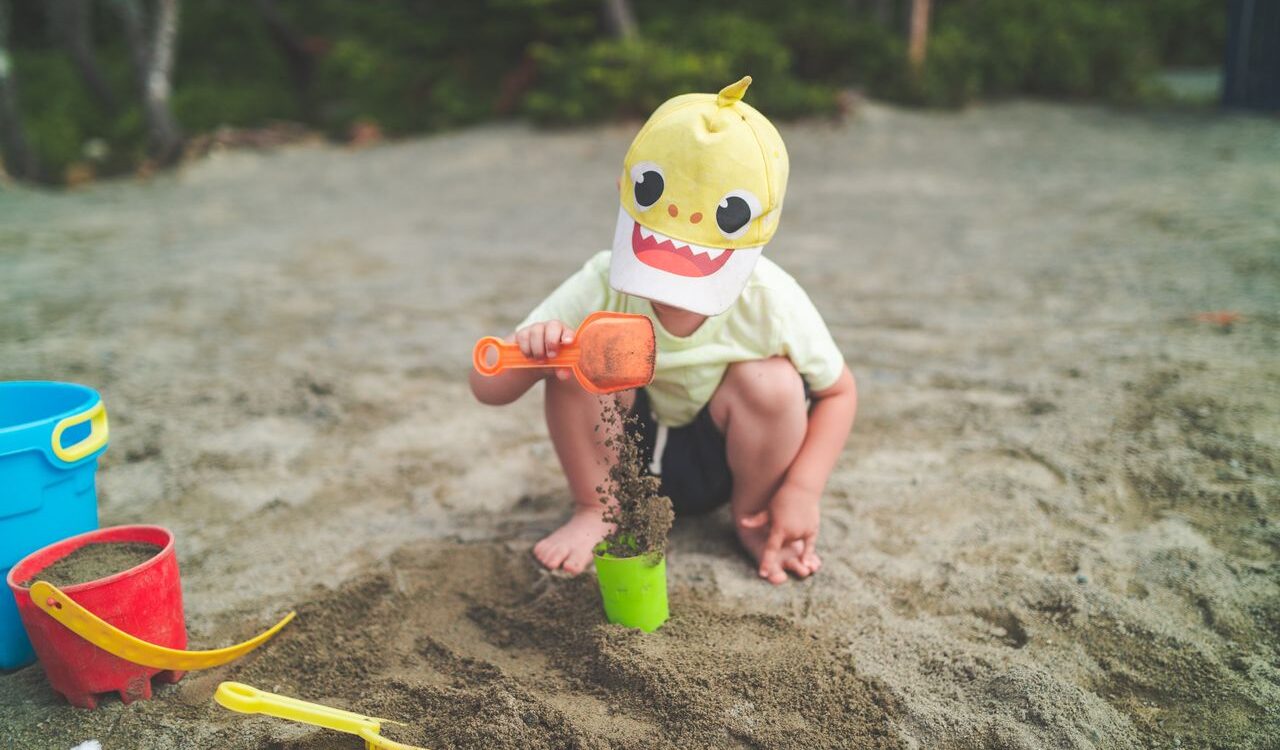
A trip to the seaside or lake with a small child rarely involves lying on a towel with a book. A child needs exercise, experimenting, pouring, building, splashing, and (usually too briefly 😉 ) rest in the shade – often in that order. Well-chosen beach toys can provide extended play, but they shouldn't completely dominate your vacation luggage. The best accessories are those that are lightweight, easy to rinse, and can be used in multiple ways.
How to choose beach toys for children so that they are not a one-time attraction?
Beach toys are best when a child can use them in a variety of ways . A bucket isn't just for carrying water—it can be a mold, a container for shells, a "pot" in a sand kitchen, or a part of an obstacle course. A shovel can dig, pour, draw lines, smooth the surface of a castle, and help create channels. The less a toy imposes a pre-defined scenario, the longer a child can use it creatively.
When packing, it is worth following a simple rule:
- 1-3 sand toys,
- 1-2 into the water,
- one for more intense physical activities (e.g. ball, paddles, frisbee)
- 1-3 calmer activities for rest (e.g. memory, books, graphics tablet for drawing).
This provides the child with a variety of stimuli, and parents don't have to carry around a whole beach shop in their bag . For younger children, the most important factors are the material's safety, the size of the pieces, and the ability to easily grasp the toy. Older children are more likely to need a challenge: a goal, rules, a task to complete, or an element of competition.
Baby Beach Toys: Less Stimulus, More Safe Exploration
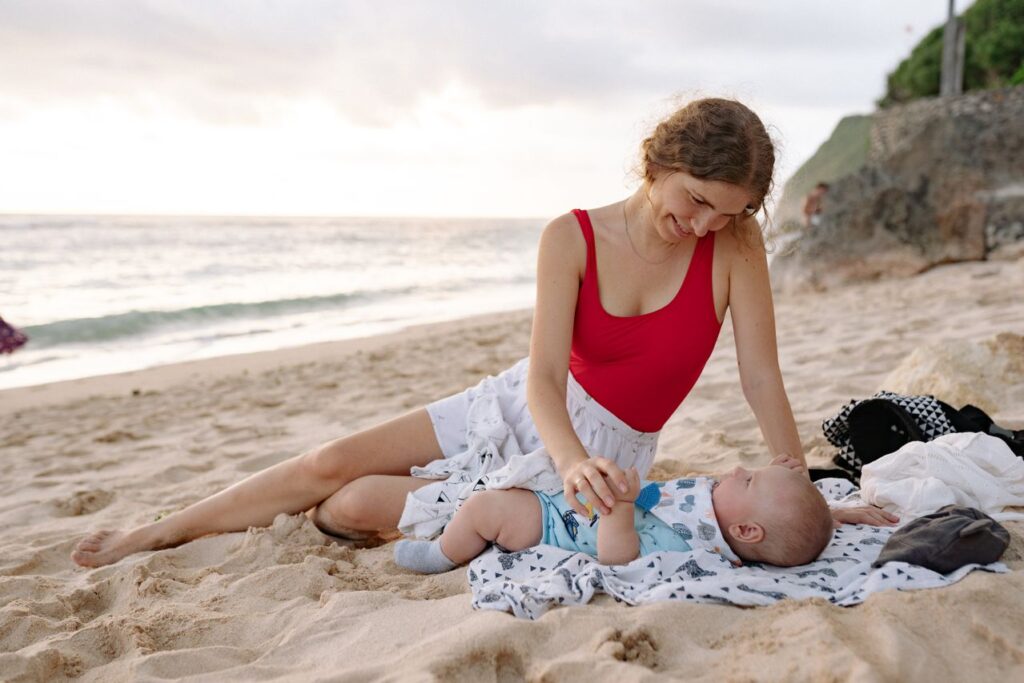
Beach toys for babies should be simple, large, soft, or flexible, without small parts or sharp edges . For a child who is still exploring the world through touch and mouthing, complicated sets with many pieces won't work. A soft ball, a larger mold, a water teether appropriate for the child's age, a silicone bucket, or a lightweight watering can with a large handle are better choices.
At this age, beach play is primarily a sensory experience. Babies touch wet and dry sand, observe particles flowing, hear the splash of water, and practice supporting, reaching, and rotating their bodies. By showing toys from different perspectives, we encourage children to reach symmetrically with both arms, change positions, and move freely.
Once your child is sitting upright, you can offer them inflatable beach toys, such as a shallow pool with a small amount of water for splashing around , placed in the shade of an umbrella so that an adult can always keep an eye on them. Even a few centimeters of water require supervision, as infants haven't yet fully developed the defenses that would allow them to safely cope with a loss of balance in the water.
What to pack for a baby?
A good mini-set would be:
- silicone bucket,
- one larger silicone mold,
- soft ball,
- a teether or sensory toy that can be easily rinsed,
- a light contrast book or a waterproof book for viewing in the shade.
This set does not take up much space and allows you to alternate activity with movement, touch and moments of silence.
Silicone Beach Toys: Why Are They So Good for Younger Children?
Silicone beach toys are especially practical because they can be easily squashed, taking up less space in your bag . They're also easy to wash and usually more resistant to damage than toys made of hard plastic.
Soft buckets, watering cans, molds, and shovels don't have sharp edges, reducing the risk of injury if a child accidentally steps on them, sits on them, or falls while playing. They also fit well in small hands, which is especially important for toddlers who are still learning to grip precisely and often use more force than necessary.
Not every silicone toy is a good choice, however. It's important to check the age rating on the packaging, cleaning instructions, and quality of workmanship . The pieces should be large enough to prevent swallowing. In practice, it's better to take three good-quality silicone beach toys for a baby than a large set of molds from which the child will only use two.
Beach toys for 5-year-olds: building, role-playing, and first tasks
Beach toys for 5-year-olds are designed to support longer, more planned play. Children this age often enjoy creating a "base," a "restaurant," a "port," a "construction site," or a "shell shop." It's worth taking advantage of this readiness for themed play and packing accessories that have more than one purpose: a collapsible bucket, a shovel, a strainer, a small watering can, a few molds, and a lightweight figure or vehicle with large, sand-resistant wheels.
A 5-year-old enjoys seeing the results of their work. Therefore, building canals, bridges, wave barriers, ball runs, or a "river" leading from a bucket to a dug pond is a great idea. Children dig, knead, carry water, crouch, stand, and change positions—doing exactly what their bodies need for proper development.
Small set, lots of scenarios
For a 5-year-old, all you need is a set: a bucket, a shovel, a rake, two molds, a strainer, a watering can, and one ball (or several smaller balls). With these few items, you can create a mud kitchen, a shell lab, a castle, a waterway, and even invent a fun activity like throwing balls into holes in the sand.
A toy that has multiple uses has a better chance of not being abandoned in a hotel room after a single afternoon.
Beach toys for 6-year-olds: construction, experiments and movement
Beach toys for a 6-year-old should give the child a sense of agency. A six-year-old usually wants to invent their own rules, improve their structures, and test what will collapse and what will withstand the pressure of water . Instead of buying more molds, it's better to bring beach toys that allow for experimentation: a collapsible funnel, a water spout, a strainer, a lightweight ball, a fabric Frisbee, or a small nature observation kit.
At the beach, a six-year-old can test which sand sticks together better, how to create a channel to prevent water from escaping sideways, or how to build a wall that will temporarily withstand a wave. It's fun, but also a practice in cause-and-effect thinking. Parents don't have to guide the child step by step; just ask a good question: "What can we change to make the water flow slower?" or "Which part of the castle needs reinforcement?"
At this age, you can also introduce light physical games : throwing at a target, carrying water in a cup without spilling, slaloming between flip-flops, or racing a ball along a sand track. The beach toys needed for these activities take up minimal space in your luggage and allow your child to burn off excess energy without chaotically running between other beachgoers' towels.
Beach Toys for 7-Year-Olds and Up: A Challenge Instead of "Keep Busy"
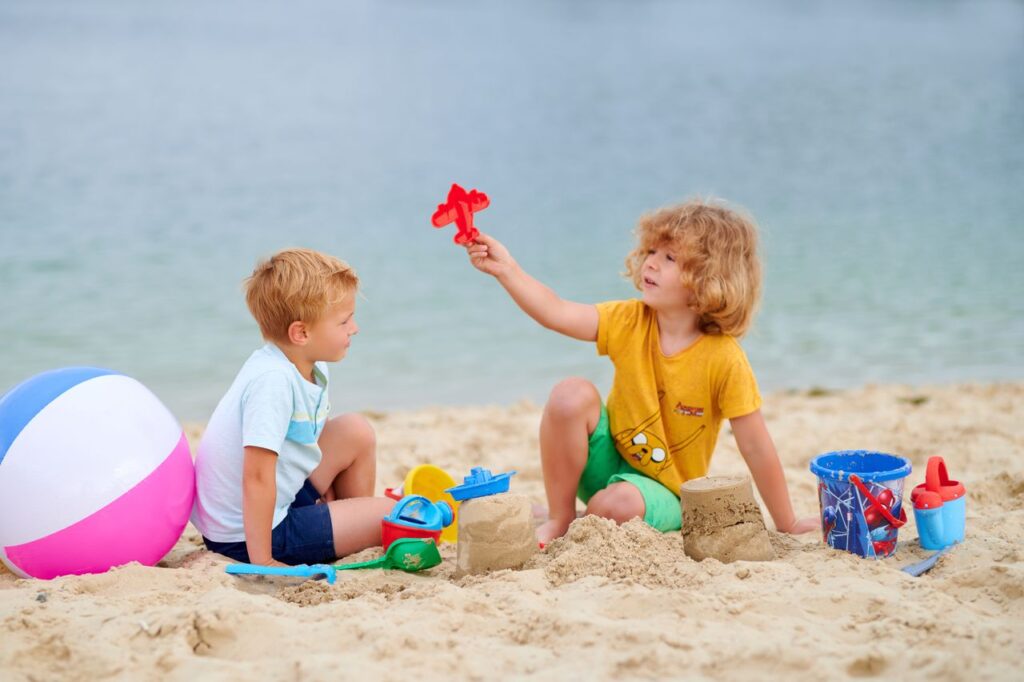
Beach toys for a 7-year-old should be more task-oriented . School-age children often quickly give up on playing with simple shapes if they don't see a purpose in the game. Therefore, beach toys for older children might include a soft frisbee, a lightweight ball, a beach badminton set, ball rackets, a foldable kite, waterproof activity cards, or a magnifying glass for observing shells and pebbles.
Older children can be involved in projects like building a harbor, planning a ship route with sticks, creating a beach map, competing for the tallest tower made of wet sand, or searching for natural shapes on the beach—a heart, a spiral, a triangle, a bird's footprint. Such activities effectively combine physical activity, concentration, and independence. They don't require many beach toys, and they don't end after five minutes.
For siblings of different ages, it's best to choose accessories that can be scaled. A ball can be used as a rolling object for a younger child, or as a game element with rules for an older child. A strainer can be used for pouring sand for a three-year-old, or for an "archaeological search" for a seven-year-old.
Inflatable beach toys: attractive, lightweight, but requiring very sensible rules of use
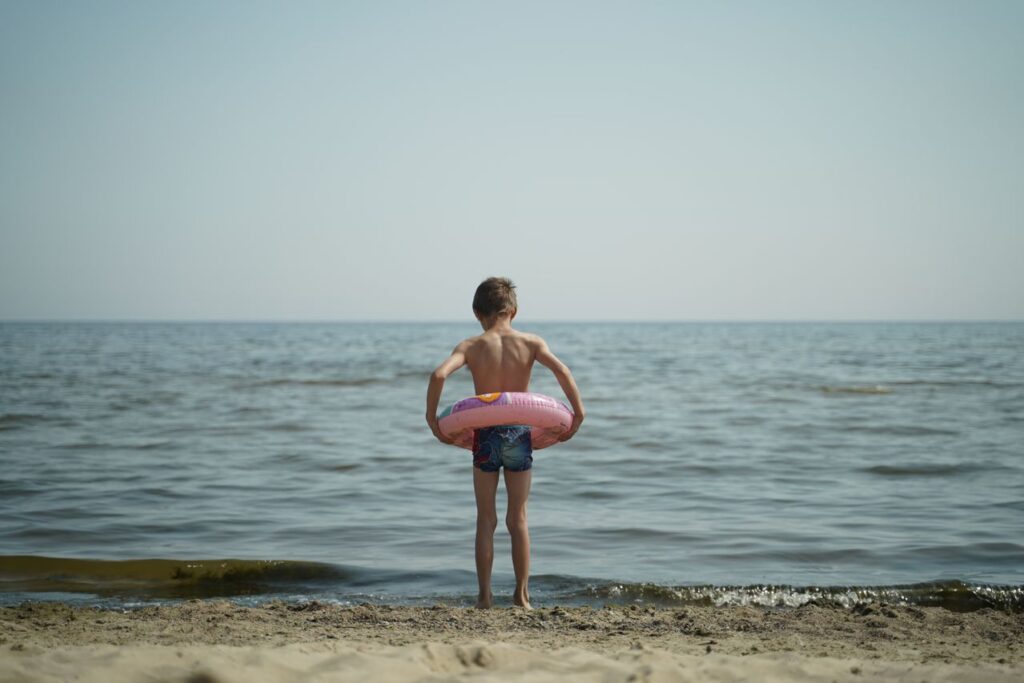
Inflatable beach toys are tempting parents because they take up very little space when deflated. Rings, balls, small mattresses, or inflatable swimming animals can provide a child with a lot of fun, but it's important to clearly separate the toy from safety equipment . Inflatable beach toys can break (or puncture), slip off the body during play, accidentally tip a child into the water, or be carried farther from shore by wind and current.
The most important rule is: a child may only use an inflatable toy on the beach under the direct supervision of an adult.
We don't "peek constantly," we don't observe from afar, and we don't assume that just because a child has an inflatable ring or mattress, they're safe. In the water, what matters is the distance that allows a parent to react immediately . For younger children, this usually means having an adult right there, within arm's reach.
Inflatable beach toys used on a lake or at sea require special care . A mattress with a child "on board" can quickly float away from the shore, especially in windy conditions or large waves. A child, even one who can swim, can lose their orientation, become frightened by the deeper water, make a sudden movement, slip off the mattress or inflatable crocodile, and choke. This poses a real threat to life , so inflatable beach toys are best considered a supplement to shoreline play, not a way for a child to swim independently without adult supervision.
Inflatable beach toys and food, heat and cold water
There's no need to strictly ban bathing for hours after eating, but after a substantial meal, it's wise to wait about 30-60 minutes before engaging in vigorous water play . This is primarily for your child's comfort: a full stomach, jumping waves, swallowing air, and exertion can contribute to nausea, abdominal pain, or poor well-being. After a light snack, further water play doesn't require such a long break.
On a hot day, don't rush into cold water . Children should gradually acclimate to the temperature: first their feet, then their calves, hands, forearms, and neck, and only then slowly, with the assistance of an adult, should they enter deeper.
A sudden change in temperature can be a major stimulus for the body, especially after prolonged exposure to the sun. It's also a good idea to take regular breaks in the shade, make sure your child wears a hat, uses SPF sunscreen with high UV protection, and offer your child water to drink frequently. It's also worth monitoring whether your child isn't getting cold despite the heat and fun they're having in the water.
After every situation in which a child chokes on water, submerges their face and chokes , or after being submerged, has difficulty catching their breath for a moment, the parent should remain vigilant - if you want to learn more about what dry drowning is before going on holiday, be sure to read our article on this topic.
How to match toys to a child's temperament?
A very active child will usually benefit more quickly from playing with a ball, slalom, water-carrying tasks, and building large structures than from sitting with molds for long periods. A more cautious child may need to start by playing on dry sand, touching water with their hand, pouring it into a bucket, and observing others. For sensory-sensitive children, sand, wind, wet clothes, and noise can be challenging. In such cases, beach toys with predictable textures work better: a silicone bucket, their own towel as a "base," a container of water for controlled splashing, a book, or observational tasks. Not every child needs to roll in the sand and jump through waves right away.
Brave children who immediately run to the water need clear boundaries.
Before entering the beach, it is a good idea to establish a simple rule: only enter the water with an adult, and inflatable beach toys do not float beyond a designated place, and when they start to float away, the child calls an adult instead of swimming into deep water on their own.
Summary: which beach toys should you choose?
The best beach set isn't the largest set, but a few lightweight and multi-functional beach toys appropriate for the child's age. For a baby, large, safe silicone beach toys are ideal; for a 5-year-old, simple building tools and themed play; for a 6-year-old, toys for experimenting with sand and water; and for 7-year-olds and older children, in addition to classic beach toys, include more activities, games, and movement challenges.
Silicone beach toys win in terms of practicality, and inflatable beach toys can be a good addition, provided that the parent treats them as a toy and not as protection for the child while playing in deeper water.
The most important rule around water is simple: a child should always be within the immediate sight and attention of an adult . Even in shallow water, a toddler can fall, choke on water, or momentarily lose their bearings, so a parent's vigilance is more important than any toy or swimming accessory. Well-chosen beach toys make organizing a vacation day easier, but it's the presence of an adult and sensible rules that make time by the sea or lake a safe, beautiful memory for the whole family.