




Baby mat – when, what type and what to pay attention to before buying?

When putting together a layette, parents often hear, "You absolutely must buy a baby mat, it'll be so useful!" But is it necessary to have one at home from the very first days after birth? When is it advisable to use a baby mat? Which one should you choose – foam, fabric, puzzle-shaped, roll-up, or an activity mat with a bar? When can an activity mat or water mat truly support a toddler's activity? In this article, we organize the most important dilemmas for parents: from choosing the type of mat, through material safety, to practical aspects such as cleaning and storage.
When is it worth using a baby mat and is it really necessary to buy one for the layette?
A baby play mat is quickly becoming one of the most practical accessories in the home , especially when parents want to create a safe space for their little one to play freely on the floor . If you're wondering when it's best to use a baby play mat, the answer is: it can be introduced from the very first days of life, but its role changes as the child grows.
Expert advises
From the very first days of life, a baby needs opportunities to move on a stable, flat surface, where they gradually acquire new skills: first, they learn head control and become comfortable with the tummy time position, then they develop forearm support, reaching for toys, turning, pivoting, creeping, and crawling. A surface that's too soft, collapsing under the weight of the body, can hinder a child's spontaneous movement, while a too slippery, often cold surface, such as tiles or laminate flooring, doesn't provide a baby with good support and comfortable play in the first months of life.


Why can't a carpet replace a baby mat?
Most often, it's for very prosaic hygienic reasons: the mat can be quickly wiped down, and in the case of fabric models, thrown in the washing machine . However, when a baby spits up while lying on their tummy, express washing and drying the mat is usually not on a parent's wish list.
For newborns, the play mat isn't yet intended for intense play. At this stage, it can be a calm, clean, and stable place for short, supervised activities , such as:
- lying on your back and watching your parent's face;
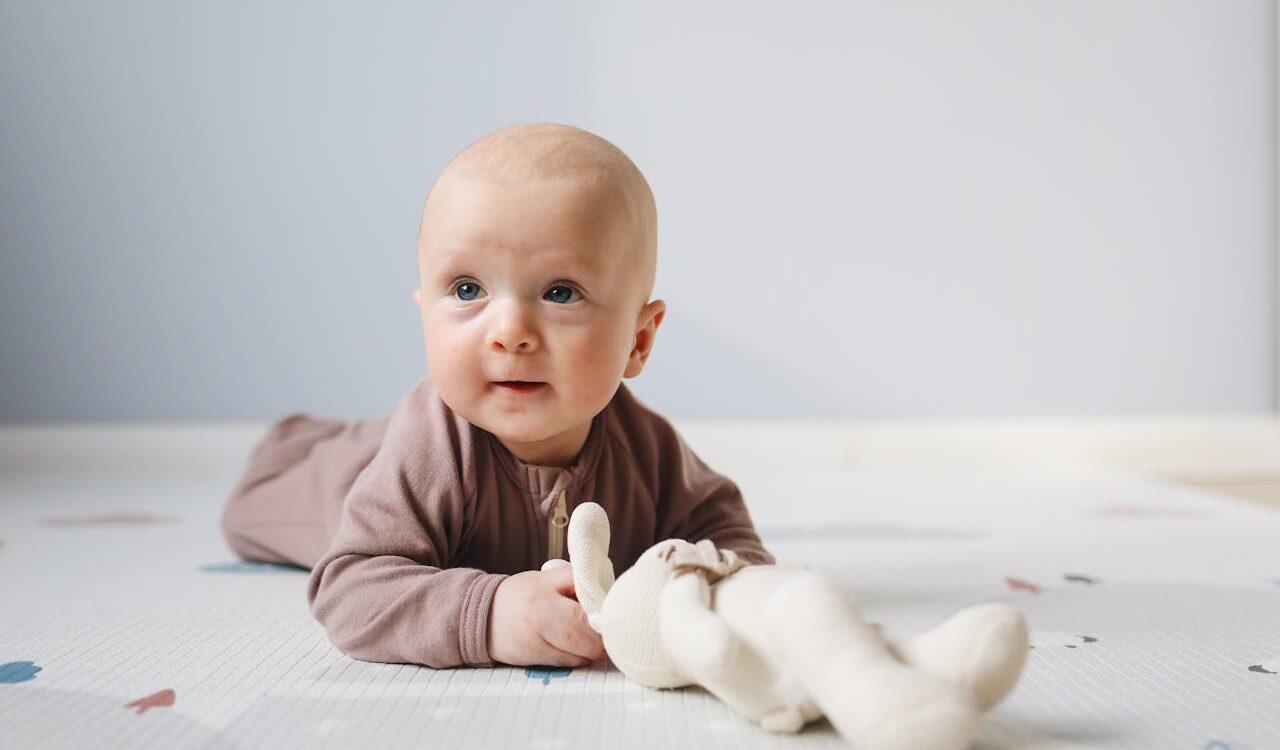
- short trials lying on your stomach, repeated several times a day – a fabric or foam mat placed on the floor is the best surface for infants to practice supporting themselves on the forearms;
- looking at a simple, contrasting toy;
- free movement of arms and legs;
Types of baby mats: which one will work best in your everyday life?
1. Foam puzzle mat
✅ Pros:
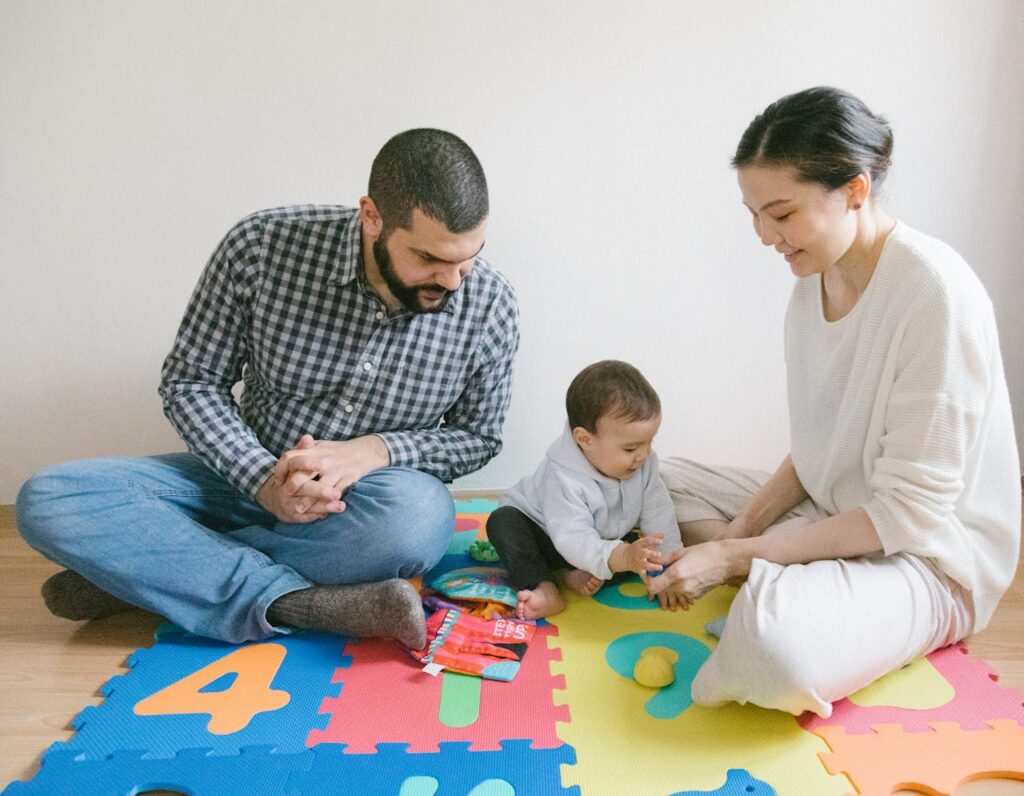
Its greatest advantage is the ability to adjust the surface to the child's age, developmental stage, and space . Initially, you can set up just a few pieces, and as the baby becomes more mobile and needs more space to play, gradually expand the space by adding more puzzle pieces. A puzzle mat is also easy to store and often affordable.
⚠️ Cons:
Joints between pieces can make hygiene difficult . Spills can cause milk or saliva to get between the puzzle pieces, so the mat should be regularly unfolded, washed, and thoroughly dried. It's also worth checking the edges and corners—especially if your child begins to grab, suck, or chew on them. The product should have clear information about its ingredients, intended use for children, and safety standards.
2. One-piece foam mat, rolled up
✅ Pros:
It's usually one of the most practical options for everyday use. The lack of seams makes it easy to quickly wipe down the surface , and the large, uniform space works well for babies who are increasingly exploring space.
⚠️ Cons:
When rolled up, it can still take up a lot of space , so it won't be convenient for storage in every apartment. Before purchasing, it's worth checking that the mat doesn't slip on the floor, doesn't curl at the edges, and doesn't warp after a few weeks of use.
3. Fabric mat
✅ Pros:
It's lightweight, aesthetically pleasing, and easy to take out and about : to grandparents', on a trip, or to a restaurant. Many models are machine washable, which can be a great convenience with a baby. It works well as an additional mat, especially when parents want to quickly create a clean space for their child to play.
⚠️ Cons:
It absorbs moisture more quickly and may wrinkle and slide across the floor. It typically doesn't provide as stable a surface as a foam mat , so it may be less practical as a baby's primary mat during periods of intensive motor development. Once your baby begins to become more motorically active, around 3-4 months of age, it's a good idea to replace a cloth mat with a foam one at home, and only use the cloth mat in emergencies when you're leaving the house with your little one for extended periods.
4. Educational mat with a bow
✅ Pros:
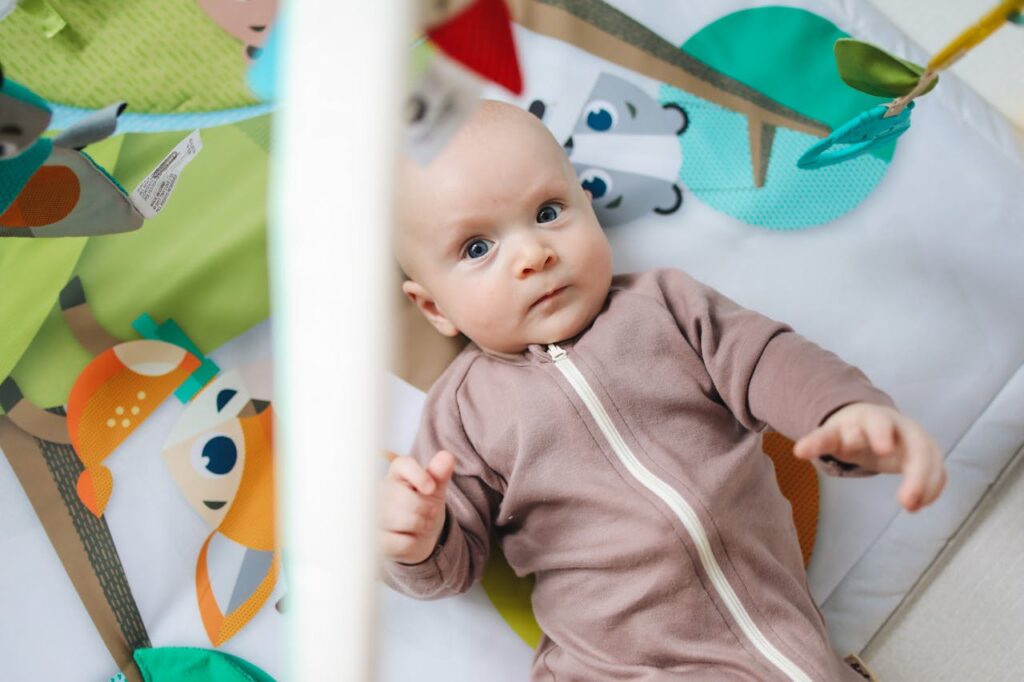
It can encourage the child to observe, focus, reach out and engage in short activities close to the parent.
⚠️ Cons:
Many activity mats have a small surface area, so they quickly become inadequate for a more mobile baby. It's also worth remembering hygiene—models with many sewn-in, rustling, or plush elements can be more difficult to clean thoroughly if a child spills water.
Expert advises
A play mat, toy bar, and play accessories shouldn't restrict a child to a single position or replace a larger space for free movement on a safe surface, which is usually the floor at home. A play bar can be helpful for a few minutes, or at most, a dozen or so minutes, when a parent wants to put the child down in a safe place and keep them close, for example, while cooking, but it shouldn't be the only way to organize a toddler's activities throughout the day. As a child becomes more mobile, begins to roll, change positions, pivot, crawl, and prepare to crawl, the more important the mat's larger surface area, its stability, and its ability to slide on the floor become. Therefore, when choosing a play mat, it's worth considering not only what interests the child today, but also whether such an activity mat will be practical in a few months.
5. Baby water mat
✅ Pros:
It can be a short-term sensory experience for a child who tolerates tummy time well and is interested in what's happening on the floor in front of them. The movement of elements beneath the mat's surface can encourage observation and short-term activity while supported. The water mat takes up little space and is easy to store.
⚠️ Cons:
It doesn't replace a baby's traditional play mat for everyday activity. It typically has a small surface area and serves more as an accessory than as the baby's primary play space. It requires constant adult supervision, regular inspection for leaks and quality of construction. If parents are wondering when a water mat makes sense for a baby, it's worth considering it as a later addition to short tummy time activities (until around 3 months of age), rather than a staple in the layette.
Since when will an activity mat be a good solution for babies?
A play mat for babies can be a good choice, usually around 2-3 months of age , when a baby begins to show a greater interest in their surroundings, focuses their gaze on a parent's face or a toy for longer periods, has better head control, and gradually begins to deliberately move their hands toward objects. At this stage , simple, calm stimuli work best :
- as few playing and lighting elements as possible,
- delicate rattle,
- a plastic mirror or a pendant on a bow placed sometimes on one side, sometimes on the other and centrally, at the height of the toddler's chest, to encourage the child to look and turn their head to both sides, grab, join their hands in the midline of the body, and put the toy in their mouth.
The best choice will be an activity mat for babies, where you can detach the arch, change the position of the toys and gradually adjust the number of stimuli to the toddler's abilities.
Safe baby mat – what to look for before buying?
When it comes to babies, the word "safe" should mean more than just a soft surface and a pretty pattern. Your little one lies on the mat with their whole body, touches it with their hands, drools, and over time, may suck or chew on the edges . Therefore, when purchasing, it's worth assessing not only the color, thickness, and price, but above all the markings, ingredients, quality, and manufacturer's reliability.
CE on the baby mat: what does it really mean for a parent?
A safe baby mat should have a CE marking , manufacturer or importer details, age information, instructions for use and cleaning, and warnings in Polish . The CE mark signifies the manufacturer's declaration that the product meets the safety requirements of the European Union. It is not a quality certificate issued by an independent institution, but rather basic information that parents should look for before purchasing.
You can read more about safe toys for children in another article on EpozytywnaOpinia.
EN 71 standards: resistance, small parts, flammability and migration of substances
If a product is sold as a toy, baby activity mat , sensory mat, puzzle mat, or water mat, it's worth looking for information about compliance with the EN 71 series of standards . For parents, the following are particularly important:
- EN 71-1 — concerns mechanical and physical properties, including the risk of detachment of small elements, sharp edges or structural strength;
- EN 71-2 — refers to the flammability of materials;
- EN 71-3 — concerns the migration of specific elements, i.e. checking whether selected substances are not released from the material in quantities exceeding the permissible limits.
This is especially important for products with additional elements: pendants, mirrors, teethers, rustling parts, sewn-on tags, or moving parts inside the water mat. Babies don't use the mat "gently"—they explore it with their whole body, hands, and mouth.
In this article we write more about hazardous substances in children's toys.
Foam and Water Mat Composition: Why Should You Ask About REACH and Phthalates?
For foam, puzzle, roll-up, and water-based mats , the chemicals used in the materials are particularly important . It's worth checking whether the manufacturer declares compliance with REACH (Registration, Evaluation, Authorization, and Restriction of Chemicals) requirements and the absence of prohibited phthalates such as DEHP, DBP, BBP, or DIBP. This is important because phthalates are used, among other things, as plasticizers in some materials, and babies may have prolonged and very close contact with the mat's surface.
The Office of Competition and Consumer Protection (UOKiK) and the Trade Inspection Authority (Inspectorate of Trade) regularly point out that problems with children's products can involve not only manufacturing quality but also deficiencies in labeling, incomplete instructions, lack of importer information, or the risk of undesirable chemicals. Therefore, certificates, ingredients, and packaging information are not the invention of an overzealous parent. They help determine whether a product comes from a reliable source and meets safety requirements.
Textiles next to baby's skin: when is OEKO-TEX a real value?
If you're choosing a fabric mat or an activity mat with fabric elements, an additional advantage is the OEKO-TEX STANDARD 100 certificate , preferably in product class I , intended for babies and children up to 3 years of age. This certificate means that the textile product has been tested for numerous harmful substances, and the requirements for this class are the most stringent due to the intensive contact of the material with young children's skin.
It's worth remembering, however, that OEKO-TEX applies to textile safety and doesn't replace the CE marking if the product is a toy. It's best to treat it as an additional confirmation of material safety for fabric mats, plush pendants, rustling elements, and accessories that a child might touch with their face or put in their mouth.
Summary: Which baby mat is best, and what should you remember?
The best baby mat isn't the one with the most features, but the one that's safe, stable, easy to clean, and truly comfortable for everyday use . It's worth considering not only when you should start using a baby mat, but also where you'll be using it: in a small child's room, or, as is often the case, in the very center of the living room, making it a part of the décor (or maybe you'll want to move it from place to place?).
A mat that seems sufficient for a newborn today may be too small for a more mobile baby in a few months.
Therefore, a good choice should take into account the child's development, the size of the apartment, house, or room, storage, hygiene, aesthetics, and the family budget. An activity mat or a water mat can be a valuable addition to short play sessions, but they won't replace a larger, stable space for daily activity.
Baby Play Mat - Parents' Most Frequently Asked Questions in a Nutshell (FAQ)
Baby play mat – when is it worth buying?
A play mat can be introduced to babies from the first days of life, provided the baby is under adult supervision. For newborns, it will be a place for short, quiet activities, and over time, it will become a space for turning, reaching for toys, crawling, and even crawling.
When will an activity mat be a good choice?
A play mat for babies can usually be useful around 2-3 months of age, when the baby is becoming more attentive to their surroundings and gradually begins to move their hands towards objects. It's best to choose models that allow you to control the amount of stimulation, detach the arch, and adjust the toys to the child's developmental stage.
A water mat for babies – since when does it make sense?
A water mat for babies can be an additional, short-term sensory attraction, usually when the baby tolerates tummy time well and is interested in what's happening on the floor in front of them. In practice, it's most often considered around three months of age or later, always under adult supervision.
Which baby mat is easiest to clean?
One-piece or foldable mats with a smooth, washable surface are usually the easiest for daily cleaning. Puzzle mats are practical and modular, but the seams need to be checked regularly, while fabric mats wash easily but absorb moisture more quickly.
Can an activity mat replace a large floor mat?
Not always. A play mat with a bouncer can be helpful for short play sessions, but it often has a small surface area and isn't sufficient for a child who is starting to change positions, crawl, or prepare to crawl. It's best to treat it as a supplement, not the infant's only activity space.
What should you pay attention to when choosing a safe mat for your baby?
It is worth checking the CE marking, manufacturer or importer details, instructions in Polish, intended age, material composition and information about safety standards, e.g. EN 71. For foam and water mats, the quality of the material, lack of a pungent odor, durable and smooth edges, tight welds and purchasing the mat from a reliable source are also important.
Is a large baby mat better than a small one?
A small mat may be sufficient at first, but babies quickly need more space. A larger mat works better as the baby begins to roll, pivot, crawl, and move across the floor. It also provides more comfort for parents who frequently play with the baby on the mat.
Should a baby mat be placed in the child's room or in the living room?
It's best to place it where the parent can safely monitor the child and be close to them. In many homes, the mat quickly finds its way into the living room, where daily family life takes place. Therefore, when choosing a mat, it's important to consider not only the child's development but also the mat's size, aesthetics, storage, and ease of cleaning.
Bibliography:
European Centre for Quality and Promotion – toy certification, reference documents. Link (accessed May 15, 2026)
Author