




Towel for a newborn: which one to choose to be soft, safe and comfortable after bathing?


For many parents, every newborn bath is one of those moments where tenderness mixes with a little stress: the baby is wet and delicate, and we want to wrap them in something soft and absorbent as quickly as possible to prevent them from getting cold. This is when it becomes clear that a good baby towel is not just a cute addition to the layette, but a real support in daily care. Parents often ask: which towel is best for a newborn, what size to choose, and does a hooded model really make bathing rituals easier? In this guide, we explain the characteristics of a baby bath towel, when it's worth buying a larger towel for a growing child, and what to choose when faced with the dilemma: bamboo or cotton.
Baby towel: which one to choose for starters?
A good towel for a newborn should combine three key features: gentleness on the skin, good absorbency, and comfort for everyday use. In practice, it's worth paying attention not only to whether the manufacturer describes it as a "soft towel for a newborn," but also to the specifics:
- natural composition of the material — it is best if the towel is made of cotton, bamboo or a mixture of these fibers;
- method of finishing — soft piping, flat seams and careful hemming reduce the risk of the towel causing irritation;
- no rough applications on the inside — Embroidery, patches, or decorative elements should not be placed where they come into direct contact with the child's skin. If present, they should be properly secured on the inside and should be as flat as possible.
- washing recommendations — Baby bath towels are used frequently, so it's good to be able to wash them regularly without quickly losing their shape, absorbency, or pleasant texture. When considering which baby bath towel is actually worth buying, check whether the manufacturer allows washing at higher temperatures, which will significantly simplify maintaining the towel's hygiene;
- opinions of other parents — the most helpful are those that tell not only about the appearance of the towel after unpacking, but also about whether, among other things, the towel for a newborn remained soft and did not discolour even after several washes, whether it absorbs water well and whether the seams and trims have maintained a neat finish during use.
When choosing the first bath towel for a baby, it is worth looking at it as a care element, not just a layette accessory.
A large hood with long bunny ears or large embroidery may be eye-catching, but they often prove impractical for everyday use. The attractive appearance of a baby towel shouldn't be more important than a friendly composition, soft hems, and a material that absorbs moisture well without rubbing the baby's delicate skin.
The type of fabric largely determines whether a towel will be lightweight, fluffy, quick-drying, or more resistant to frequent washing. Therefore, another important question is: which baby towel should you choose, cotton or bamboo—and which is better for newborns and infants?
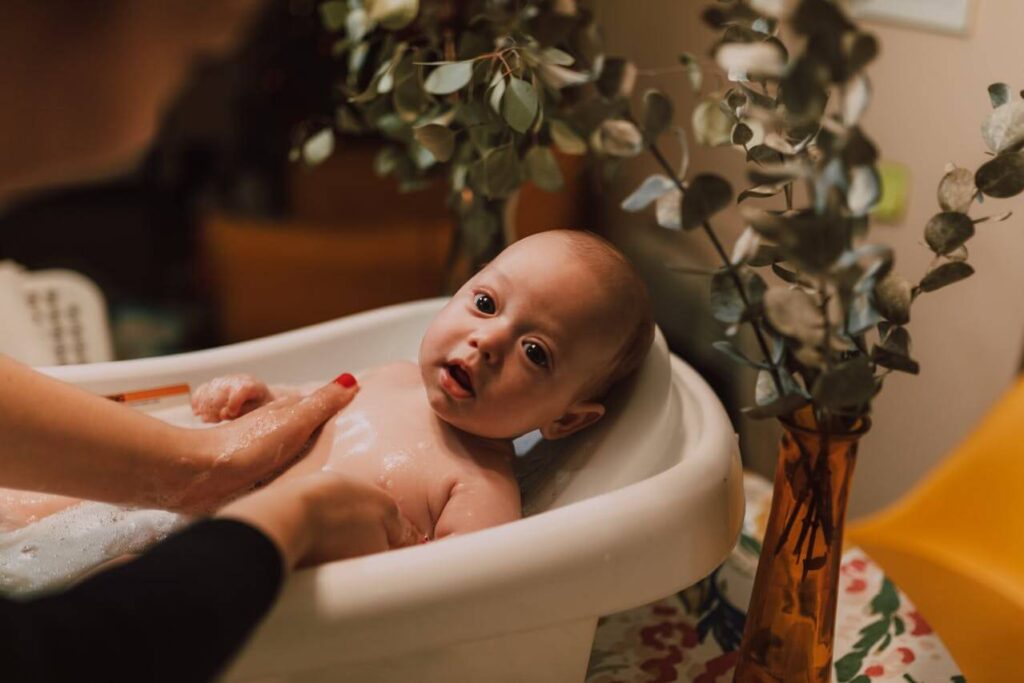
Read more about giving your newborn their first bath in this article.
Bamboo or cotton towel – which material should you choose for a baby towel?
When parents consider which baby towel to choose, they most often come across cotton, bamboo, bamboo-cotton blends, or those with a synthetic fiber blend. And this is worth considering, because the material really matters : it affects softness, absorbency, durability, drying time , and how well the towel holds up to frequent washing.
Cotton towel
This is a classic and very practical choice when considering which towel to choose for a baby, not just for the first few months of life. Good quality cotton is absorbent, durable, and usually holds up well to frequent washing, so a cotton bath towel for a baby can be useful after a daily bath, as well as after swimming, or during a trip.
Whenever possible, it is worth choosing organic cotton, as it comes from crops grown with greater care to limit the use of harmful chemicals, and when it comes to textiles that come into direct contact with a newborn's skin, this is an additional argument for a safer choice.
When considering which towel to choose for a child, it is also worth paying attention to certificates, such as OEKO-TEX Standard 100 , which confirms that the product has been tested for the presence of harmful substances, or GOTS , which refers to organic textiles and covers both the origin of the fibers and specific environmental and social requirements during the production stages.
Bamboo baby towel
It's often chosen by parents who want an exceptionally soft, lightweight, and pleasant-to-touch bath towel for their baby. Most towels labeled "bamboo" aren't made from tough bamboo fibers, but rather from bamboo viscose , a soft cellulose fiber derived from bamboo. High-quality bamboo viscose can be very soft, absorbent, and comfortable on baby's skin.
When we are wondering which towel to choose for a newborn, it is worth checking the full composition on the label when purchasing: is the towel made of 100% bamboo viscose, a blend of bamboo and cotton, or does it only have a small admixture of bamboo fibers?
In reviews of bamboo baby towels, parents point out that, compared to cotton, bamboo towels can be more demanding to care for— not all of them can withstand high wash temperatures, intense spin cycles, or tumble drying . Some bamboo baby towels also prove to be slightly less absorbent than cotton ones. Therefore, it's worth reading reviews of bamboo towels carefully: the most helpful are those in which parents comment on whether the material remains soft, absorbent, and hasn't lost its shape after several washes.
Bamboo-cotton towel
It can be a good compromise if a parent is looking for a soft towel that is also more "everyday" and resistant to frequent use. The addition of cotton can improve the fabric's durability and stability, while bamboo fibers or bamboo viscose give it a softer, more enveloping character . Such a baby bath towel is worth considering when you want to combine pleasant softness with practicality, but the composition, grammage, washing method, and stitching quality remain key.
Microfiber or polyester-rich towel
It dries quickly and is lightweight, making it convenient for travel, the pool, or the beach . However, it won't be the first choice as an everyday bath towel for a newborn. For younger children, it's better to choose natural materials or those based primarily on cellulose fibers, and consider synthetic towels as a supplementary, "travel-friendly" option.
In practice, if parents ask: which baby towel to choose, bamboo or cotton, the answer is: both can work, but under different conditions.
Cotton will be more durable and predictable in daily washing, while a bamboo baby towel can be exceptionally soft and lightweight, as long as it holds up well when cared for according to the manufacturer's recommendations. When choosing a first towel for a newborn, it's safest to consider not just the material's name but a full set of characteristics: composition, absorbency, softness, frequent washing, careful finishing, and parental feedback after prolonged use.
Newborn towel: what size will be comfortable to start with?
When parents are putting together a layette and wondering what size towel they should choose for a newborn , a good starting point is a size around 75 x 75 cm or 80 x 80 cm . These are some of the most common sizes for hooded towels for young children—large enough to wrap your little one up after a bath, yet still convenient for everyday use.
Which towel for a newborn: smaller or larger?
A towel that's too small can expose legs and backs, but one that's too large, thick, and heavy won't always be comfortable and will complicate bathing rituals rather than making them easier. Therefore, if parents are wondering which towel to buy for a newborn first, a 75–80 cm size is a practical starting choice. A larger model, such as 90 x 90 cm or 100 x 100 cm , can be considered if you want to use it for a longer period of time, but it's worth considering not only the dimensions but also the thickness and weight of the material.
What towel should you use for your baby as they grow?
For a slightly older baby, a larger bath towel may simply be more comfortable, especially if the current model no longer comfortably covers the child's entire body. Parents often notice this very simply: after bathing, the towel needs to be constantly stretched to dry various parts of the baby's body, or it's difficult to cover the head, back, and feet simultaneously. In this case, a baby bath towel in a size of 90-100 cm or larger will be more practical, as it better fits a growing, increasingly active child.
Baby bath towel with or without a hood?
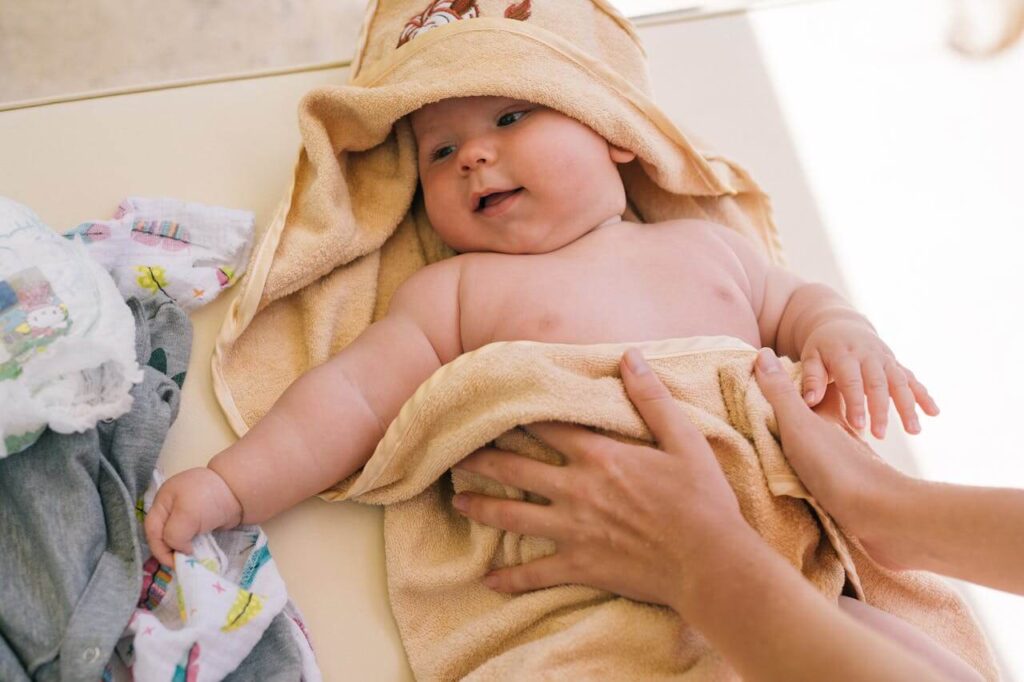
A baby bath towel with a hood is very practical for the first year of life. The hood, sewn into the corner of the towel, helps protect a wet head, helps keep the towel in place, and gives your baby a pleasant feeling of being wrapped up . A hood can also be sewn into the long side of a rectangular towel, making it much easier to wrap your baby around their torso after bathing.
Does an older child still need a hood? It depends. For a one- or two-year-old, a hooded towel can still be comfortable, especially after a swim at home, at the pool, or after playing in the garden with water. A hood may be less necessary for an older preschooler , especially if the child has short hair, dresses quickly, and prefers a "grown-up" towel. It's worth eliminating the hood if the child dislikes it, takes it off, gets frustrated when putting it on, or if the hood itself is large, heavy, and takes a long time to dry. The most important thing is that the towel is functional for the individual child and family, not just consistent with a layette list or current trends in children's textiles.
Baby Bath Towels: How Many Are Worth Having?
It's a good idea to have at least two bath towels in a baby's layette, and ideally three . One is for use, one is in the wash, and the third is for emergencies—especially if the baby spills water after bathing, the towel doesn't have time to dry, or bath time unexpectedly ends in a major "nursing mess."
With a small child, textile hygiene is crucial. A wet towel left in a ball on a changing table, washing machine, or bed quickly becomes unpleasantly smelly and less hygienic. After each bath, it's a good idea to hang it up to dry thoroughly. Regular washing, thorough drying, and storing it in a dry place are just as important as the fabric itself.
However, you don't have to buy a large set all at once. It's better to have two or three good-quality towels than six random, rough, and poorly absorbent ones. When it comes to daily care, quality truly trumps quantity.
Towel hygiene is just as important as regularly changing bed linen – in this article, an IMiD pediatrician advises how often you should change bed linen at home.
Baby towel - a small purchase, great comfort after bathing
A good baby towel doesn't have to be the most decorative or expensive. Above all, it should be soft, absorbent, appropriately sized for their age, and comfortable for everyday use. A hooded towel around 75-80 cm is usually best for a newborn , a larger model for an older infant, and a classic rectangular towel with or without a hood for a toddler.
When choosing between bamboo and cotton, it's worth considering not fashion, but the child's needs, care routine, and the actual rhythm of the family bathroom. Because after bathing, one thing is most important: a warm, soothing wrap that helps end the day pleasantly—for both child and parents.