




Baby doesn't want a pacifier: when to try and when to give up?


Your baby cries, can't calm down or fall asleep, and you try again to offer the pacifier and... once again, you see your little one spit it out with a look of protest. Questions quickly arise: am I doing something wrong, or should I keep trying? How can I teach a baby to use a pacifier, and is it even worth it? Does every baby need a pacifier? Or is it normal for a newborn to not want a pacifier, simply preferring the breast, closeness, or another way to soothe themselves? In this article, we explain the most common reasons why a baby refuses a pacifier, what to do if a baby spits out a pacifier and cries, when patience and a change of pattern are enough, and when difficulties with a pacifier may signal a need to consult a specialist.
Baby Refuses Pacifier? It's More Common Than You Think
A pacifier is one of those accessories parents buy with great hope: maybe it will help them get through difficult moments during the day and help them wind down before bed? Maybe it will give their child an additional way to calm down when the closeness and loving presence of a parent don't help? However, in practice, many parents quickly discover that simply offering a pacifier is only the beginning – the child refuses the pacifier, turns their head away, pushes it out with their tongue, starts crying even harder, or simply refuses to suck.
Expert advises
Although a baby doesn't need a pacifier for proper development, it's worth remembering that in newborns and younger infants, pushing the pacifier out with the tongue doesn't always indicate a conscious "aversion" to the pacifier. It may be a natural oral response or a signal that the baby isn't yet able to comfortably enclose the nipple, stabilize it in the mouth, and begin sucking gently.


Problems with children accepting pacifiers are shown by the results of research conducted in the #MamyRecenzują club.
The problem with pacifier acceptance is clearly visible in the results of the practical testing of BIBS pacifiers conducted by the #MamyRecenzują club. A full 53,2% of parents admitted that their child had previously had trouble accepting other pacifiers . This is important because the questions searched for— how to teach a child to use a pacifier , what to do when a baby spits out the pacifier and cries —are often driven by simple parental fatigue and a sense of helplessness, not a lack of effort.
" Unfortunately, previous attempts with round pacifiers ended in failure – the baby would spit them out immediately. He also had problems with gagging and coughing when trying to suck, which caused the child a lot of stress, " wrote one parent, describing his previous experience.
Another mother noted: " It was difficult to latch on, the baby would spit out the pacifier immediately ."
There were more similar voices: " He didn't want the pacifier, he spat it out, cried, and wouldn't calm down with it " or : "He put the new pacifier in his mouth and spat it out. That was the end of his pacifier adventure . "
These are just a few quotes from our survey of 79 parents, but their message is crucial: if a newborn refuses a pacifier, or if an infant spits it out despite repeated attempts, it doesn't necessarily mean the parent is doing something wrong. Many families face the same challenges. So where do we begin when we want to figure out how to get a child used to a pacifier—without pressure or struggle? First, it's important to understand why a toddler might reject it.
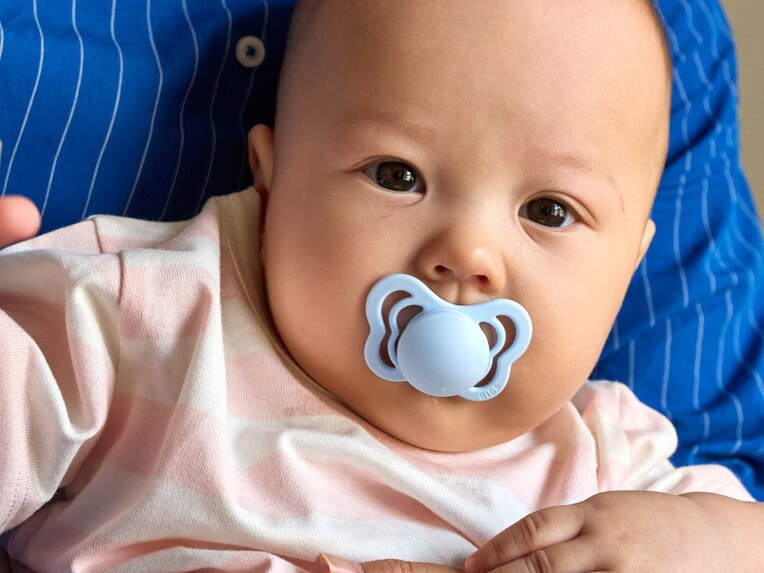
Why doesn't your baby want a pacifier? First, check the fit.
When a newborn does not want a pacifier, the first instinct is to look for a way to teach the child to suck a pacifier.
Expert advises
Remember that a pacifier is not a mandatory part of baby care. Therefore, we don't have to get our child used to a pacifier at all costs. However, if we want to try giving our baby a pacifier and they don't accept it, first check whether the pacifier is truly appropriate for the child's age, mouth size, sucking strength, and preferences.
If you are at the stage of deciding whether to give your newborn a pacifier at all , please also check out our separate article written with Dr. Alicja Zawiślak, M.D., dentist and orthodontist at the Institute of Mother and Child.
Newborn Doesn't Want a Pacifier? 'Age on the Package' Isn't Everything
Pacifiers are usually labeled with age ranges , such as 0–6 months or 6–18 months , but a child's age doesn't always tell the whole story. A small, full-term newborn, a premature baby, or a child with a smaller mouth may have difficulty using a pacifier that, in theory, is age-appropriate but in practice turns out to be too large, too long, or too bulky.
Expert advises
Parents shouldn't rely solely on the age rating on the pacifier packaging. If a baby spits out the pacifier and cries, both the shape and size of the suction part and the individual fit of the pacifier in the child's mouth can be important. For small infants, premature babies, or children with smaller mouths, a model designed for a younger age group may be better tolerated. For larger babies, it may be worth considering a pacifier from the next age group—always while maintaining safety guidelines. The pacifier shield should be large and stable enough to prevent the child from inserting it entirely into their mouth, while also having ventilation holes to allow airflow. If a parent has any doubts about the appropriate size or shape of the pacifier for a specific child, it's worth consulting with a pediatric dentist, orthodontist, or speech therapist.
If a newborn doesn't want a pacifier, it's worth checking not only the age on the packaging, but also how the pacifier actually fits in the mouth and the shield on the baby's face: whether it doesn't press on the nose and whether it doesn't leave red marks on the face.
Is your pacifier falling out of your mouth? Weight could be a factor.
A pacifier that 's too heavy or poorly balanced can make it difficult for a baby to hold it in their mouth, especially in very young babies who are still developing their sucking, lip, and tongue coordination. If the pacifier constantly falls out, the baby can quickly become discouraged : instead of associating sucking with calm, they become frustrated by constant, unsuccessful attempts to suck. This suggests that when a baby spits out the pacifier and cries, it's worth examining not only the nipple but also the entire pacifier design.
Pacifier material: comfort that baby feels immediately
Children can react very clearly to differences that seem almost imperceptible to adults : the hardness of silicone, the elasticity of rubber, the texture of the tip or even the smell of the material.
Therefore, if a child does not want a pacifier, it is worth remembering that the problem may not be the pacifier itself, but the specific material from which it is made.
The silicone tip of one pacifier may be too stiff for a baby, while another model—also silicone—will be softer or more comfortable in the mouth. Some babies may prefer a natural rubber tip because it's more flexible and works differently during sucking. That's why, when trying to get a baby used to a pacifier, it's worth comparing not only the size but also the material of the suction part.
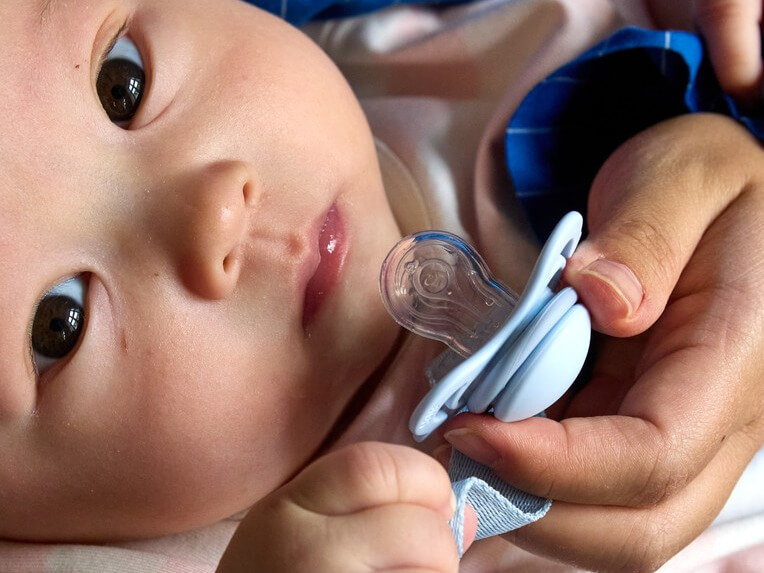
How to get your baby used to a pacifier? Sometimes the shape of the tip is key.
The material determines how the pacifier feels , but the shape of the tip influences how well a baby can grasp and hold it in their mouth . The most popular pacifier tips include symmetrical and anatomical pacifiers, also known as orthodontic pacifiers. They differ in how they fit in the mouth and the type of lip, tongue, and jaw movement they require from the baby.
One baby will find a symmetrical pacifier more comfortable, while another will find an anatomical one. If your baby spits out the pacifier and cries, this can be a sign that this particular shape may not be to their liking.
BIBS brand pacifiers with a positive opinion from the Institute of Mother and Child: what did parents appreciate?
When parents wonder how to teach their child to use a pacifier, they're often looking not so much for the "perfect product" as for a pacifier that will be comfortable for their little one from the very first time: light, soft, well-fitting in the mouth, and non-irritating. In tests of BIBS pacifiers conducted by the #MamyRecenzują club, these very features frequently appeared in parents' comments.
One of the mothers wrote:
" I used the BIBS pacifier and had a very good experience. It's soft and natural, so my baby accepted it quickly and calmed down with it. There was no problem with spitting up, which sometimes happened before ."
Another parent noted:
"Hania accepted the new pacifier almost immediately. We had no trouble getting used to it – she eagerly took it from the start and calmed down very quickly. It's clearly comfortable and well-fitting for her, as it didn't fall out of her mouth and she used it much more calmly than some of her previous pacifiers . "
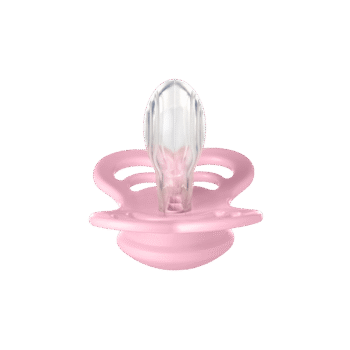
See the BIBS pacifier models tested by parents with a Positive Opinion from the Institute of Mother and Child Experts:
Recommended products

Dentist, Orthodontist, Molecular Biologist, Acting Head of the Department of Maxillary Orthopedics and Orthodontics, Institute of Mother and Child
The profile of the shield matters
Parents also valued the pacifier's shield – not only its appearance, but also how it interacted with the delicate skin around the mouth. In the study, 88,6% of parents reported no skin marks or irritation when using the tested pacifier, and survey responses included comments that the pacifier "did not irritate the baby's face or leave marks on the cheeks or chin ." Parents also noted the shield's openwork design, which can promote better skin ventilation and reduce saliva retention around the mouth.
Some babies who have difficulty grasping and holding a pacifier do better with a shield that is more face-oriented – this design can help them hold the pacifier more securely in their mouth. On the other hand, babies with a strong sucking reflex , who develop red calluses on their cheeks and chin even after short pacifier use, may benefit from models with a slightly outward-curved shield . If marks remain on a baby's face after using a pacifier, it's worth testing pacifiers with a different shield profile. Sometimes, calluses are not solely determined by suction power, but also by the individual shape of a child's mouth – some babies simply have chubbier cheeks than others.
If we decide to give our baby a pacifier, it is worth spending some time finding a model that the baby will accept and that will not irritate their delicate skin.
Parents admit that accepting a pacifier may require several gentle attempts.
The results of the #MomsReviews test of BIBS pacifiers also confirmed that pacifier acceptance isn't always immediate . This is valuable advice and confirmation of what we wrote in the article: if a baby spits out the pacifier and cries upon first contact with a particular pacifier, it's sometimes worth giving the little one a few quiet opportunities to test it out before deciding that the pacifier isn't suitable for them at all.
Does every baby have to suck a pacifier?
The absence of a pacifier isn't, in itself, a developmental problem or a sign that the parent is doing something wrong, although for many families, a well-chosen pacifier can be a real help in the daily care of an infant. A pacifier isn't mandatory – it can, but doesn't necessarily have to, be given to a child . Therefore, if, after trying many different models, sizes, and shapes, your little one consistently refuses to suck on a pacifier, it's worth accepting their preferences for other self-regulation methods. There's really no point in "fighting" and searching for ways to teach your child to suck on a pacifier at all costs.
Some children eagerly use a pacifier to fall asleep and calm down, others consistently reject it, preferring the breast, closeness, sucking on their own hands, or completely different methods of regulation.
How to get your baby used to a pacifier if the first attempts are unsuccessful?
It's best to offer a new pacifier when your little one is relatively calm—not during prolonged crying or overtiredness . One trial is usually not enough. To get your child used to a pacifier, it's wise to test the same model for several days, at different times and in different situations, observing whether your child tries to wrap their mouth around the pacifier, immediately pushes it out with their tongue, whether the pacifier falls out, or whether it causes significant discomfort.
Expert advises
It's also worth remembering that a pacifier shouldn't be used as a way to delay breastfeeding, especially in newborns and breastfed infants. However, if you decide to give your baby one, it's recommended to wait until the breastfeeding mother's milk supply is well established, approximately 6-8 weeks after birth. It's safest to treat a pacifier as one of the tools that supports calmness – alongside on-demand feeding and closeness. A pacifier should also be used safely, especially during sleep and naps: free from strings, pendants, or other elements that could pose a strangulation or choking hazard.
How can you tell if a pacifier is worn out, and how often should you replace it? We've written more on this topic in our other article: " How often should you replace pacifiers? Signs of wear and safe use . "
When should you consult a specialist about pacifier problems?
Expert advises
It's worth consulting a specialist if your baby not only rejects the pacifier but also has difficulty breastfeeding or bottle-feeding: they frequently release the breast or bottle nipple, take a long time to eat and tire quickly, gain weight poorly, or become upset and cry during feeding instead of calming down. Also concerning are any choking, coughing, a strong gagging reflex, or the baby's significant distress when gently trying to offer the pacifier. In such situations, an assessment of feeding (e.g., whether the baby is latched on correctly) and oral function, including the functioning of the lips, tongue, cheeks, and jaw, and whether the baby can coordinate sucking, breathing, and swallowing, may be helpful. Depending on the symptoms, a consultation with a pediatrician, speech therapist, midwife, or a certified lactation consultant may be helpful.
The child does not want a pacifier – what is worth remembering?
If your child doesn't want a pacifier, don't start by thinking you have to teach them at all costs – a pacifier isn't necessary for proper development. However, if you want to try introducing a pacifier, first check that it's a good fit : in terms of size, weight, material, shield, and tip shape. Offer it in quiet moments for a few days . If, despite your best efforts, your newborn refuses the pacifier, or your baby spits it out and cries, treat this as important information about your child's needs – not as a parenting failure.
And if you are looking for pacifiers made of safe, certified materials, with a Positive Opinion from IMiD experts, you will find them at EpozytywnaOpinia.pl.
Medical consultation