




Herpes in a child – how to recognize it and what medications to use?


Cold sores in children can appear unexpectedly and immediately trigger a flurry of questions: are cold sores serious in children? What does a cold sore look like on the lips, and can it also appear on the nose or chin? Can cold sores appear in an infant, such as an 8-month-old or a one-year-old? In this article, we explain what cold sores are in children, how they become infected, and where on a child's body they can appear. We also offer advice on how to treat cold sores in children, what medications are commonly used, and when to consult a doctor.
Herpes in a child – what causes it and how does infection occur?
Cold sores in children are caused by the herpes simplex virus (HSV ) . There are two types: HSV-1 , which typically causes lesions on the lips and face, and HSV-2 , which primarily affects the genital area. Importantly, this virus is exclusive to humans, so you can only catch it from another person (and therefore not from an animal).
At what age can a child become infected with herpes?
First contact with the virus can occur at different stages of life:
- Newborns: They can become infected from their mother during childbirth (perinatal infection) or, less frequently, during the fetal period (intrauterine infection).
- Babies and toddlers: Most cases of the first illness, i.e. the so-called primary herpes infection is observed in children between 6 months and 5 years of age.
- Youth: At this age, HSV-2 infections are more common, usually through sexual contact.
What happens to the herpes virus in children after infection?
It is important to understand two important concepts that explain why herpes in children recurs:
- Latency (sleep): After the first infection, the virus does not disappear from the body. It "hides" in nerve cells and goes into a dormant state, producing no symptoms.
- Reactivation (awakening): When a child's body is weakened (e.g., by stress, another illness, overexertion, or even exposure to strong sunlight or hypothermia), the virus can "wake up." It then migrates back to the skin and causes the blisters to reappear, e.g. on the lips, nose or chin, i.e. recurrent herpes.
Expert advises
Most children and adults (around 80-90%) are asymptomatic, meaning they may not even know they carry the virus. However, approximately 10% of people develop visible and painful lesions on the lips, chin, or other areas of the body. These skin lesions should always be discussed with a doctor to rule out other conditions associated with the rash.


In another article on EpozytywnaOpinia we write more about infections that may cause a rash to appear on the child's skin.
How does herpes infection occur in children?
The herpes virus is very contagious and is transmitted in several ways:
- Direct contact: This is the most common route. A tender gesture, such as someone with an active cold sore (commonly called a "cold sore") kissing a child, or a child touching the affected person's affected skin with their fingers and then putting them in their mouth, is all that's needed.
- Droplet route: The virus can spread through the air when talking at close range, sneezing or coughing.
- Common items: A child can become infected by using the same cutlery, cups, towels or toys that have previously been used by an infected person (e.g. 8-month-old 9-month-old baby can become infected if a parent infected with herpes licks the pacifier or spoon with which they feed their baby).
Expert advises
Herpes simplex virus (HSV) infection can also occur without any visible symptoms, such as blisters or ulcers on the lips, nose, or chin. It is estimated that the majority of infections (up to 70%) occur during this asymptomatic phase.
Here are the key reasons:
- Asymptomatic viral shedding: Many people infected with the herpes virus have no visible symptoms, but can still periodically infect others because the virus can be present in saliva (HSV-1) or vaginal secretions (HSV-2).
- Lack of awareness of carrier status: Since most infections are asymptomatic or mildly symptomatic, these people often do not know that they are carriers and do not take any precautions, which contributes to the unconscious spread of the virus in the population.
- Risk and form of change: Although the risk of herpes infection is highest in the phase of vesicles filled with serous fluid, the virus may be excreted by the carrier before the lesions appear (in the prodromal phase) and for some time after they have healed.
To sum up, the absence of the so-called "cold" on the lips of a caregiver or other person in the child's environment does not provide a 100% guarantee of safety, although it is precisely during active changes that the utmost caution should be exercised, for example, kissing the child and eating with shared cutlery should be strictly avoided.
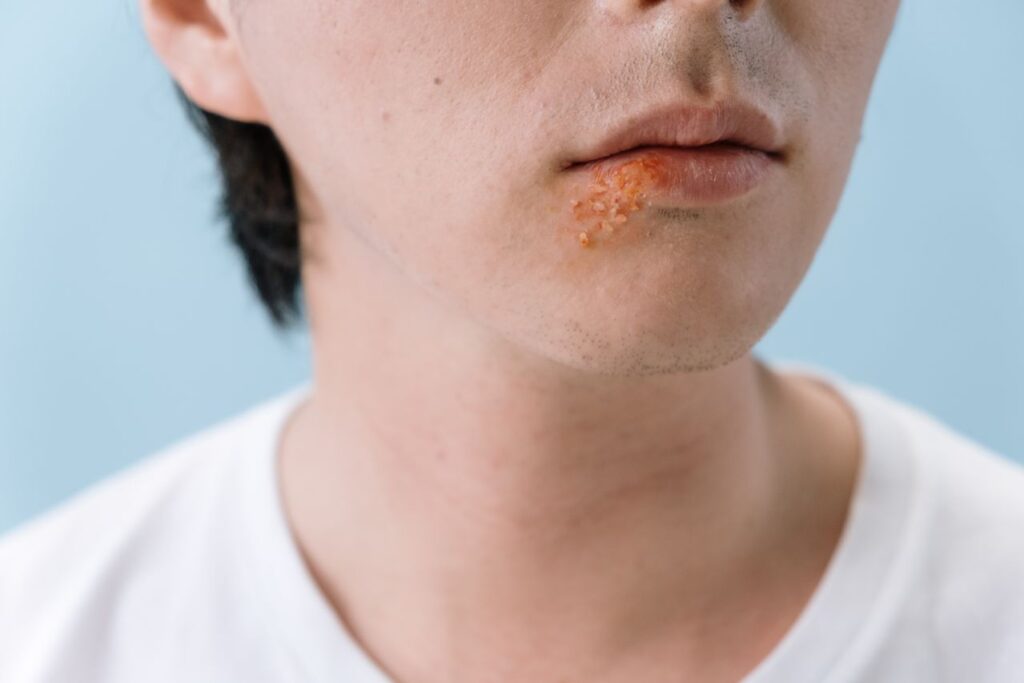
Cold sores in children and other possible locations of herpes lesions (on the nose, chin, body)
The most common form of cold sore infection in children is cold sores, which typically present characteristically around the mouth. Although HSV-1 is primarily associated with lesions on the lips, painful blisters can appear in many other locations on the face . Here are the most common places where cold sores can appear in children:
- Lip and face area: The lesions are usually located on the vermilion border of the lips (cold sores in a child), but they can also affect the skin on the chin and the area under the nose. In younger children, such as 9-month-olds, but also 2- and 3-year-olds, or slightly older children, the virus can also attack the inside of the mouth, causing painful ulcers on the gums, tongue, or palate.
We encourage you to read another article on EpozytywnaOpinia about inflammation in the oral cavity of children.
- Nose and eyes: Herpes blisters can appear directly on the nose, and in rarer cases, the virus attacks the eye area. If you notice changes on your eyelids or conjunctiva, you should see a doctor immediately, as this may damage the cornea.
- Fingers and hands: In a baby, for example 8-month-old or one-year-old babywho frequently sucks their thumb and is infected with herpes may develop what's known as herpes simplex. This is a skin infection around the nail fold, manifesting as swelling and pain.
- Skin and whole body: Although herpes on the body occurs less frequently in children with atopic dermatitis (AD) A dangerous complication may occur, which is eczema herpeticum. In this case, numerous vesicles and erosions (shallow, painful sores caused by bursting blisters) may be spread over a large area of skin on the body.
Expert advises
It's worth remembering that in infants and slightly older children, such as 2- or 3-year-olds, the first herpes infection (the so-called primary infection) usually has a more severe course than in adults. If blisters appear in unusual locations on the body or face, it's always worth consulting a pediatrician, who will diagnose and advise on how to apply topical creams to the sores and which medications to use to minimize the risk of potential complications.
What medications should be used for herpes in one-year-old children and older children, and what should be used to lubricate the skin lesions?
Choosing the right treatment depends primarily on the child's age, the severity of the infection, and the location of the blisters. Although many medications are available over the counter, any cold sore in a child, especially blisters that appear in less common cold sore locations such as the nose, chin, eyelids, or those spread across the body, should be consulted with a doctor . This doctor will be able to best determine whether it's herpes or another infection and will decide which medications are recommended and in what dose.
What should I apply to the lesions to bring relief to my child with herpes?
What to use to treat a cold sore in a child depends on the stage of the disease. For mild lesions in older children, topical treatment is usually sufficient.
- Antiviral preparations (most important): In the case of cold sores in a child, the most commonly used creams and gels contain acyclovir (a substance that inhibits the multiplication of the virus). They should be applied several times a day, preferably when the child first feels itching or burning.
- Drying and disinfecting agents: Doctors may recommend washing the blisters with a potassium permanganate solution or applying ethacridine compresses (popularly known as Rivanol), which helps to “dry” the lesions faster and prevents bacterial superinfections.
- Atopic skin care: If your little one suffers from atopic dermatitis, it is crucial to apply emollients to healthy areas of the skin to strengthen its protective barrier.
What medications do doctors most often prescribe for herpes in children?
When the infection is more severe or this is a child's first exposure to the herpes virus, the question of what to apply to the skin lesions may not be enough. Parents often ask which medications are most effective in such cases – the standard in medicine is systemic acyclovir.
- Syrups and tablets: For conditions such as painful inflammation of the gums and mouth (herpetic stomatitis), a doctor will usually prescribe oral acyclovir. For example, if you experience herpes in a one-year-old child, a convenient form of administration is a suspension, the dose of which is precisely calculated by the pediatrician based on the baby's body weight.
- Intravenous treatment: It is reserved for the most severe cases of herpes in children, such as neonatal infections, herpes simplex encephalitis, or generalized dissemination of the herpes virus. on the body.
- Painkillers: Because oral lesions can be very painful and make drinking and eating difficult, paracetamol or, after the third month of life, ibuprofen is used to improve the child's comfort and prevent dehydration.
- Ophthalmological treatment: If the virus attacks the eye, the doctor prescribes specialized eye ointments and antiviral drops (e.g. with trifluridine).
Expert advises
When considering which medications can be used to treat herpes in children, it's important to remember that acyclovir doesn't eliminate the virus from the body, but inhibits its multiplication during the period of active infection. Therefore, it's crucial to consult a doctor at the first alarming symptoms in a child, who will assess what to apply to the skin lesions and whether oral medications are necessary to shorten the duration of the illness and reduce the child's discomfort.
*Please remember that the above article is for informational purposes only, so if you suspect your child has a cold sore or you have noticed skin changes and you are not sure whether it is really herpes, contact your doctor immediately.
Bibliography (access to internet sources from 16.04.2026/XNUMX/XNUMX):
- Marczyńska M., Herpes in children, "Pediatria po Dyplomie" 2012, vol. 16, no. 2, pp. 44-49. Link
- Leszczyńska-Pilich M., Nidzińska K., Rustecka A., Kalicki B., Skin eruptions and infectious rash diseases in children in the practice of a primary care physician, "Paediatrics & Family Medicine" 2022, no. 18 (4), pp. 313-328. Link
- Majewska A., Romejko-Wolniewicz E. et al., Herpes simplex virus type 1: epidemiology and involvement of the virus in genital infections, "New Medicine" 2011, no. 1, pp. 16-19. Link: nowamedycyna.pl
- Woźniakowska-Gęsicka T., Wendorff J. et al., Herpes simplex encephalitis in children, "Epidemiological Review" 1996, no. 50 (1-2), pp. 23-29. Link: przeglepidemiol.pzh.gov.pl
Medical consultation