Dot Day in kindergarten – what is this holiday and how to prepare for it?


The notice in the preschool cloakroom reads: "Next week we'll be celebrating Dot Day – please prepare a costume." And if you're wondering for the first time what Dot Day actually means at preschool and whether you need to buy special clothing for it, you're no exception. The distinctive colorful dots represent much more than just a theme for a themed day – it's an opportunity to encourage children to create, try new things, and see their own potential.
What is International Dot Day and when do we celebrate it?
International Dot Day, celebrated on September 15 , began in 2009 when teacher Terry Shay used the book The Dot by author and illustrator Peter H. Reynolds in his class. Over time, the initiative has grown into an international event promoting creativity, courage, and collaboration.
The inspiration for the entire concept comes from the story of a girl named Vashti, who is convinced she can't draw. However, her teacher encourages her to start with the simplest possible mark—a dot. This tiny mark on the page triggers a process of experimentation and gradually allows the protagonist to rethink her own abilities. The book, The Dot, was first published in 2003.
The dot thus became a symbol of the first attempt – an action taken despite the uncertainty as to whether the result would be perfect.
What does Dot Day symbolize in kindergarten?
For a small child, it's easy to focus primarily on the colorful nature of the day. However, the educational significance of "Dot Day" resonates well with what a toddler is just learning: taking on new activities without being sure they'll be able to handle them immediately.
"I can't draw," "I can't do that," or "I'm not good at it" are phrases parents and teachers hear from children very often. Dot Day can be a good excuse to replace the question "can you?" with "where can you start? "
It's not about convincing a child that they can do everything perfectly. It's far more valuable to create space for experimentation, to find their own solutions, and to make mistakes. From this perspective, success can be as much about a spectacular piece of art as it is about a single dot drawn by a child who previously refused to pick up a crayon.
The official idea of International Dot Day focuses on creativity, the courage to create and cooperation.
Dot Day in Kindergarten – How to Prepare an Outfit Without Spending a Lot?
Themed preschool days can be a surprise for parents, especially when the appropriate attire is announced days in advance. Fortunately, you can make a polka-dot outfit from items you probably already have at home. There's no need to buy a new blouse or a complete outfit just for one occasion.
It's even better if the child participates in the preparations . Then the outfit is no longer just a parent's response to a preschool instruction, but becomes part of the fun associated with the idea of the day.
1. White T-shirt and fabric markers
One of the simplest solutions is a light, plain T-shirt and colored fabric markers. The dots can be of varying diameters, overlapping, or create a pattern of your child's choosing.
There's no need to measure them with a ruler or correct uneven shapes. If a toddler is making a T-shirt, its irregularity can be its greatest asset.
Before you start working, it is a good idea to place a piece of cardboard inside the T-shirt to prevent the ink from bleeding through to the other side of the material, and then fix the design according to the marker manufacturer's instructions.
2. Dots painted with fabric paints
A similar effect can be achieved using fabric paints. You don't even need a brush to create the pattern—circular prints can be created with a sponge, a bottle cap, a small tape roller, or your fingers.
For a child, it is also a simple art experience: they can observe how the shape and intensity of the reflection change depending on the amount of paint used or the pressure applied.
In this case, it is also best to use an older, light-colored T-shirt, whose possible imperfections will not be a problem.
3. Dots made of felt or fabric scraps
If you don't want to paint directly on the clothing, you can cut out colored circles from felt or scraps of fabric left over from around the house. Depending on your child's age, they can help choose colors, create the pattern, or trace and cut out the circles.
An adult can sew the finished pieces onto a T-shirt, sweatshirt, or skirt with a few stitches. If you're looking for a temporary solution, you can attach the dots in a way that allows them to be removed later, keeping in mind that all pieces of a small child's outfit should be securely attached.
4. Last-Minute Outfit: Colorful Polka Dots as Accessories
There's not always time to prepare an entire T-shirt. In such a situation, simply use a plain outfit and focus on the accessory: a large polka-dot bow, headband, bow tie, or paper emblem securely attached to the garment.
You can also make large, colorful cardboard circles and glue them to a paper headband. Your child can choose the colors and dot placement themselves, allowing even a very simple outfit or accessory to retain its creative character.
This solution can save the situation when we remember about the celebrations in the evening before kindergarten.
Dot Day – an art project in kindergarten that gives children freedom
If you search for "Dot Day preschool art project ," you'll find plenty of ready-made templates. However, the most eye-catching project isn't always the one that best captures the spirit of this holiday.
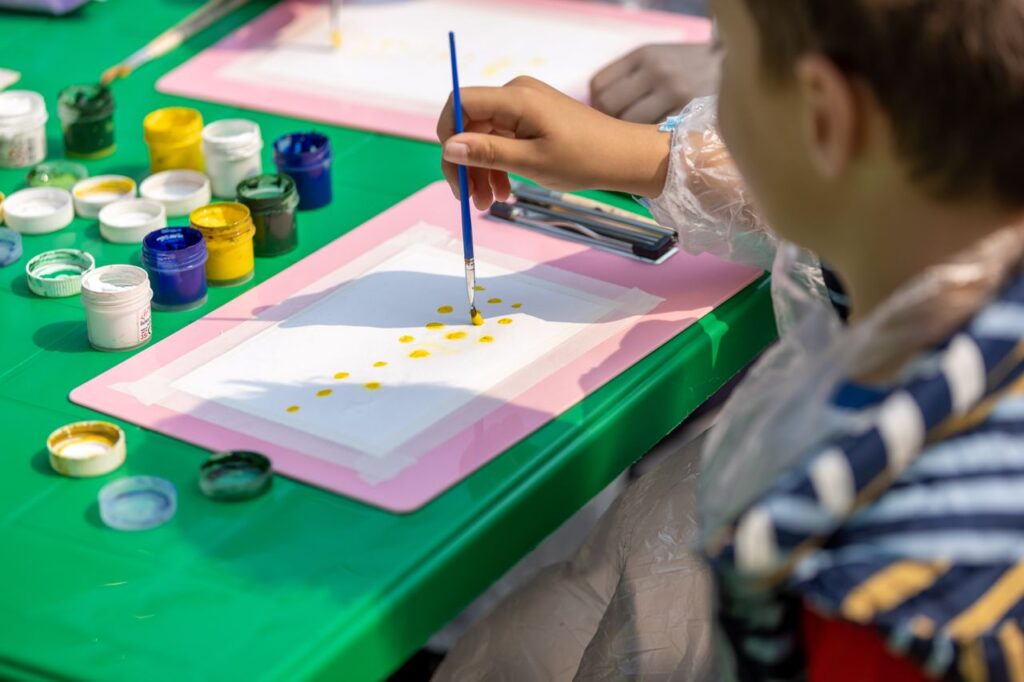
Instead of giving all the children an identical pattern to replicate, you can use a single dot as a starting point. The teacher draws or glues a circle in the center of each sheet of paper and asks the children a simple question: "What can be made from this dot? "
For one child, it might become the center of a flower; for another, it might be the sun, a ball, the eye of an animal, the wheel of a car, or a fragment of a completely abstract painting . This way, children receive the same starting task, but they don't necessarily arrive at the same result.
Another idea is to create a collaborative image . Each child creates their own dot on a small piece of paper, and then all the elements are combined into one class composition. This activity also fits well with the collaborative idea of International Dot Day.
Dot Day in Kindergarten – a scenario that doesn't require many materials
Dot Day in preschool doesn't have to involve a lot of decorations and complicated stations. You can base the lesson on several consecutive activities, each with a dot serving a different purpose.
After familiarizing the children with the story that inspired the holiday, the teacher can invite the group to discuss situations where they still don't know how to do something . Instead of asking children about their "talents," which can be quite abstract for a young child, you can use specific questions: " What did you recently try for the first time?" " What used to be difficult but is now easier?" "What would you like to learn? "
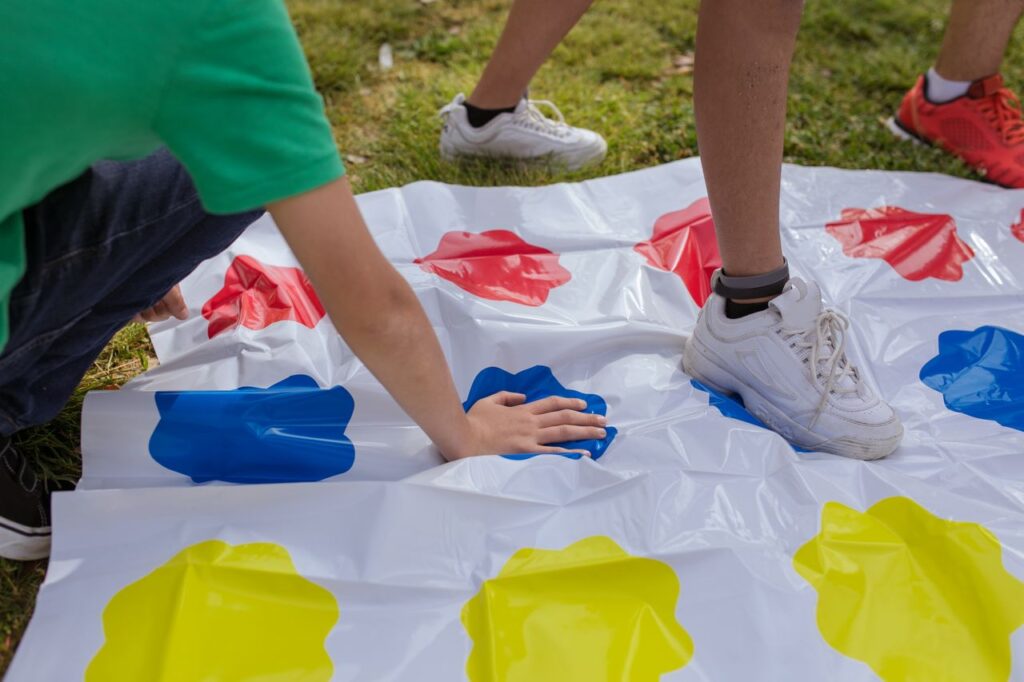
The next step could be physical activity . Colorful circles placed on the floor can become jumping areas, elements of a simple movement path, or points where children perform specific tasks.
Then, the group can move on to individual or shared art work, concluding the session with a short presentation of their work. The child doesn't have to explain whether their picture is "nice." It's much more engaging to ask about the process: "Where did you start?" "Where did this idea come from?" or "What did you draw next?" This way, the individual elements of the session are connected by a single central idea, rather than a random set of activities with a circular theme.
How can a parent use the Dot Day idea even after returning from kindergarten?
A child might come home with a colorful picture, a dot drawn on their hand, or a story about preschool games. This is a good opportunity to explore how their work was created , rather than focusing the conversation solely on the result.
Questions like "How did you figure that out?", "Which part was easiest for you?", and "Did you change anything along the way?" help children talk about their own process. They don't require them to evaluate their work in terms of "nice or bad" or compare it to other children's work.
This is where the most interesting meaning of September's fun may lie. The dot can stay in the preschool classroom, but the idea that you don't have to be good at it right away—you can just start and see what happens next —will serve your child well for much longer.
International Dot Day – a small symbol, many possibilities
When preschool announces another International Dot Day, a colorful T-shirt is merely a supplement to a much more compelling idea . A few dots painted together on an old T-shirt, a simple activity, or a card with a single dot can be enough to create a space for a child to experiment . And that's why, on this day, what a child does with their first dot is far more important than a perfectly prepared outfit.